Best Mattress Solutions for Bedridden Patients: 5 Top Alternating-Pressure Pads and Mattresses
Finding a mattress system that relieves pressure, prevents ulcers, and fits home care needs is essential for bedridden patients and their caregivers. This guide highlights the best options and explains who benefits most from each. Use this to compare features like 130 air cells, quiet pumps, waterproof covers, and weight support. The listed products are designed to reduce pressure points, improve circulation, and promote more comfortable, longer sleep for immobilized individuals.
| Product | Best For | Key Benefit | Ideal Setting |
|---|---|---|---|
| Vive Alternating Air Pressure Mattress Pad (Original) | Home care, immobilized adults | 130 air cells with quiet pump | Home use |
| Kekoy Alternating Air Pressure Mattress Pad (Beige) | Elderly, post-surgery recovery | 130 air cells, adjustable pump | Home or facility |
| Drive Medical 15076 Decompressing Foam Mattress | Budget-friendly foam alternative | High-density foam with decompression | Home use |
| Alcedo Alternating Air Pressure Mattress Pad with Static Mode | Caregivers needing stability | Static mode plus alternating cycles | Home or hospital |
| SereneLife Air Pressure Mattress Pad | Medical-grade versatility | Breathable channels, hospital-grade feel | Home or hospital bed |
Vive Alternating Air Pressure Mattress Pad — The Original Bed Sore Prevention Solution
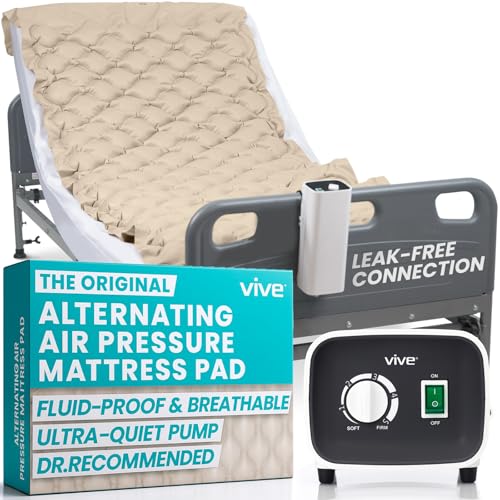
Best for immobilized patients who cannot shift weight often. This pad uses 130 air cells and a 22 dBA whisper-quiet pump to promote circulation and relieve pressure points. It distributes weight evenly to reduce bed sores and skin maceration. The durable design features heat-sealed cells to prevent leaks, making it suitable for long-term use in homes or care facilities.
Who it’s for: individuals at high risk of pressure ulcers and caregivers seeking a low-noise, reliable pressure-relief surface. Why selected: the combination of advanced air-cell technology and quiet operation supports restful sleep while actively addressing common sore-creation zones like hips and shoulders.
Caution: While the pump is notably quiet, users should monitor cycle durations and ensure the mattress fits the bed frame securely to avoid shifting during sleep.
Kekoy Alternating Air Pressure Mattress Pad (Beige)

Best for elderly care and post-surgery recovery, with 130 air cells that evenly distribute weight. The 130-cell system alternates to reduce pressure concentration on vulnerable areas. A waterproof cover helps keep skin clean and reduces moisture buildup, supporting skin integrity for those with extended bed rest.
Who it’s for: older adults and patients needing ongoing pressure relief with straightforward operation. Why selected: its combination of 130 cells and a waterproof cover provides steady protection against sores while simplifying care tasks for caregivers.
Caution: Early stages of redness or skin breakdown should be evaluated by a clinician; this device complements, but does not replace, medical care for sores or ulcers.
Drive Medical 15076 Decompressing Foam Mattress

Best for budget-conscious households needing a foam-based support surface. This decompression foam mattress offers a practical alternative when alternating pressure pads are not feasible. It includes a removable, fluid-resistant cover designed to protect the skin from moisture and friction, with corner straps for secure placement.
Who it’s for: patients who require a simple, non-electric option and caregivers seeking a cost-effective, low-maintenance solution. Why selected: it provides basic pressure relief with a focus on stability and skin-protective features, suitable for short or intermediate durations of bed rest.
Caution: Foam performance can vary with room temperature and may take 24–72 hours to regain full shape after shipping; consider room conditions when planning setup.
Alcedo Alternating Air Pressure Mattress Pad with Static Mode

Best for caregivers who want stability and flexibility. Alcedo offers an advanced alternating-pressure system with a controllable static mode, allowing all cells to stay inflated for a steady surface. The waterproof surface and durable build support long-term use in both home and medical settings.
Who it’s for: patients needing customizable surface firmness and a reliable, easier-to-clean mattress. Why selected: the static mode adds a stable baseline, which can be comforting for users who dislike frequent pressure shifts while still providing relief during regular cycles.
Caution: Ensure compatibility with your bed height and frame; a long bed may require additional straps or adapters for secure installation.
SereneLife Air Pressure Mattress Pad

Best for medical-grade versatility in a home or hospital bed. SereneLife features breathable air channels and an alternating pressure system designed to prevent tissue hypoxia. It includes an inflator compatible with standard hospital bed dimensions and a classic 78.74″ length when inflated, ensuring broad coverage for long-range support.
Who it’s for: patients requiring a medical-grade feel with reliable airflow and back support. Why selected: its combination of breathability, damn width, and hospital-grade sizing makes it a strong all-around choice for diverse care environments.
Caution: The system relies on an external pump; confirm power access and outlet safety where the bed sits to sustain uninterrupted operation.
Buying Guide: Key Considerations For Bedridden Patients
- Pressure redistribution: Choose products with 100–130 air cells for effective load distribution, especially at high-pressure zones like hips and sacrum.
- Pump noise and cycle duration: Quieter pumps (around 20–25 dBA) promote better sleep; consider cycle lengths of roughly 6 minutes for comfortable pressure shifts.
- Material and cleaning: Waterproof, breathable covers simplify cleaning and reduce moisture exposure that can aggravate skin.
- Weight capacity and durability: Look for high-density foam or reinforced air-cell designs that support long-term use and caregivers’ daily routines.
- Static mode and customization: Static-inflated options help if a user prefers a stable, non-shifting surface during certain times.
- Bed compatibility: Verify bed length and width compatibility, plus attachment features (straps, non-slip bottoms) to prevent movement during use.
- Hygiene and infection control: Waterproof surfaces and removable covers support easier cleaning in home care or facility settings.
- Intended use: Home care vs. hospital settings may influence the required durability, warranty considerations, and maintenance.
Frequently Asked Questions
- What is an alternating pressure mattress pad?
– It is a pad that inflates and deflates air cells in cycles to shift pressure away from vulnerable areas, reducing the risk of bed sores for bedridden patients. - Who should use these pads?
– Individuals at risk of pressure ulcers due to prolonged immobility, plus caregivers seeking improved comfort and skin protection for long bed rest. - Are they safe for long-term home use?
– Yes, with proper monitoring, cleaning, and bed compatibility. Always follow product care instructions and consult a healthcare professional for ongoing concerns. - Do these pads require professional installation?
– Most can be set up by caregivers at home. Some models include straps and non-slip features to secure the mattress, reducing movement during use. - What maintenance is needed?
– Regular cleaning of waterproof covers, inspection of seams, and checking the pump for noise or cycling irregularities help sustain performance. - Can I use more than one device at once?
– No; generally, each system is designed to function as a standalone surface per bed. Cross-usage can affect performance and sleep quality.