Best Low Air Loss Mattress Pump Systems for Home Use
Answering the essential question: which low air loss mattress pump system best supports pressure relief, caregiver needs, and home use? This guide highlights five top options, detailing who each product is best for and why it stands out. The top picks favor different priorities—compact setup, bariatric capacity, diagnostic alarms, or advanced pressure cycling. This summary helps buyers compare at a glance and pick the right system for long-term comfort and skin integrity.
| Product | Best For | Key Benefit | Note |
|---|---|---|---|
| MedVance Low Air Loss | Home patients needing quiet operation | Ultra quiet pump with digital customization | Includes emergency CPR deflate option |
| Drive Medical Med-Aire | General home or facility use | 20 replaceable bladders with pillow feature | Vapor-permeable cover option |
| Vive 8″ Alternating | Prevention and management of pressure ulcers | 16 air chambers with variable pump | Static head cells and pillow mode |
| ProHeal Low Air Loss | Clinically oriented therapy at home | Cell-on-cell design with multiple cycles | Moisture-wicking perforations |
| Drive Medical Med Aire Plus Bariatric | Bariatric patients needing durable support | 10″ deep air cells; strong power outage protection | Removable bladders |
Buyer’s note: each system uses a digital pump with alarms to aid care teams in monitoring pressure, circulation, and patient stability. This guide focuses on clarity, practical use, and how each option addresses common challenges such as moisture control, skin integrity, and ease of setup.
MedVance Low Air Loss Mattress System

The MedVance system uses an ultra-quiet hospital-grade pump operating under 20 dB, with dual pump cores for strong output and a digital adjustment panel. It features a diagnostic alarm system and an emergency CPR deflate function via a red tag, offering quick relief in urgent scenarios. This model employs an 8-inch cell design with a quilted cover, designed to prevent bottoming out and provide stable support for patients who are bedridden or recovering from ulcers.
Best for: Home users needing quiet operation and quick deflation during emergencies. The alarm features and digital readout help caregivers track weight and pressure. Caution: users should verify the warranty and compatibility with existing bed frames before purchase.
Drive Medical Med-Aire Low Air Loss

This system emphasizes pressure relief and circulation with 20 replaceable 8-inch bladders and a built-in pillow feature for head stability. The surface is moisture-wicking with a protective, breathable cover to help manage humidity and reduce friction. A digital pump provides diagnostic alarms and auto-defeating if the mattress remains static beyond two hours, supporting caregivers who need predictable, safe operation.
Best for: Environments requiring targeted pressure redistribution and a moisture-control surface. Limitations: the cover and sheet fit should be checked for proper compatibility with bed frames and mattresses in use.
Vive 8″ Alternating Pressure Mattress

The Vive mattress uses 16 air chambers with a variable pressure pump and a three-head-cell static pillow zone, which helps create a stable head position. It offers preset and adjustable cycling for therapy and features an ultra-quiet pump with simple mounting options to prevent clutter at the bed base. This model is well-suited for prevention and ongoing management of pressure ulcers and bedsores.
Best for: Caregivers seeking a flexible, cycle-driven solution with a dedicated head-pillow section. Caution: some users might prefer higher surface immersion for larger patients; verify cell density and height for specific needs.
ProHeal Low Air Loss Alternating Mattress

ProHeal’s system uses a cell-on-cell two-layer design with 20 bladders and four adjustable cycles (10, 15, 20, 25 minutes). It includes 18 laser-size perforations to wick moisture and maintain a cooler microclimate, helping reduce skin maceration. The LED digital panel supports an auto-firm and static mode for stability, plus an alarm network for monitoring therapy progression.
Best for: Clinically driven home therapy focusing on moisture control and comprehensive digital monitoring. Limitation: instruction on cycle timing is essential to maximize therapeutic benefits, so caregivers should review cycle options carefully.
Drive Medical Med Aire Plus Bariatric Low Air Loss

This bariatric system supports patients up to larger sizes with 10-inch-deep air cells that prevent bottoming out and provide up to 24 hours of power outage protection. It uses a digital pump with diagnostic alarms to customize therapy and can auto-return to alternating pressure if left static for more than two hours. Removable bladders add flexibility for maintenance and cleaning.
Best for: Bariatric patients needing robust support and reliable alternation with endurance during outages. Caution: ensure bed frame dimensions align with the 80-inch by 42-inch framework to avoid fit issues.
Drive Medical Med Aire Plus Bariatric Heavy Duty
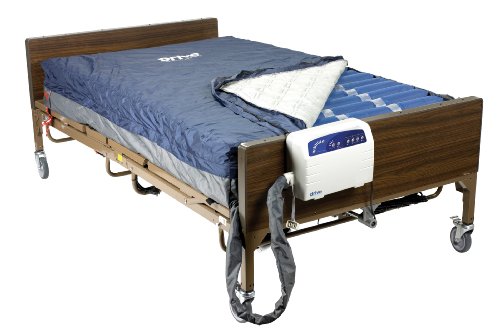
Another bariatric option, this 48″ system also uses deep 10-inch bladders with a cell-on-cell approach and 24-hour power outage protection. It includes a digital alarm system and automatic return to alternating pressure after static conditions. The design emphasizes durability for patients with larger frames who require stable pressure redistribution and sustained comfort.
Best for: Heavy-duty use with a focus on durability and consistent therapy for larger patients. Limitation: heavier weight may affect placement under smaller bed frames; verify compatibility with existing equipment.
Buying Guide: Key Considerations For Low Air Loss Mattress Pumps
- Intended environment: Home use or facility setting? Some models emphasize portability and quiet operation, while others emphasize durability and higher patient loads.
- Cell design and depth: Deeper cells prevent bottoming out and improve immersion; cell-on-cell configurations help with stability during power interruptions.
- Alarms and monitoring: Digital alarms, auto-returns, and diagnostic readouts simplify caregiver oversight and safety checks.
- Moisture management: Perforations and moisture-wicking covers reduce skin maceration and heat buildup, critical for ulcers and long bed rest.
- Power outage protection: Systems with extended runtime or easy deflation during outages help maintain therapy without frequent interruptions.
- Maintenance and cleaning: Removable bladders and washable covers simplify cleaning and sanitization in home or facility settings.
- Compatibility: Bed frame dimensions, mattress size (inches), and anti-bottoming features should align with existing equipment.
Frequently Asked Questions
- What is a low air loss mattress pump best for? – It provides continuous microclimate control and pressure redistribution to help prevent bedsores for patients with limited mobility.
- How do I choose between alternating pressure and low air loss? – Alternating pressure cycles shift weight, while low air loss maintains a consistent microclimate; many systems combine both for enhanced therapy.
- Do these systems require specialized setup? – Most include a digital control unit and straightforward inflations; however, verify bed compatibility and follow manufacturer instructions.
- Are there safety features I should look for? – Alarms, auto-deflate, and power outage protection are important to monitor therapy status safely.
- Can I use these at home without professional supervision? – Yes, for home use with caregiver oversight; consult clinicians if the patient has complex wounds or specific medical requirements.
- What maintenance is necessary? – Regular cleaning of bladders and covers, periodic replacement of worn components, and inspection of alarm indicators.