Best Low Air Loss Alternating Pressure Hospital Bed Mattress Options for Home and Facility Use
Choosing the right low air loss alternating pressure mattress depends on patient needs, budget, and whether the setting is home or facility care. This guide highlights five top options suitable for preventing and managing pressure ulcers, offering clear, objective comparisons. Each product is best for specific scenarios, from compact home use to bariatric or high-care environments. Below is a quick summary table of the selected mattresses to help you compare at a glance.
| Product | Best For | Key Benefit |
|---|---|---|
| MedVance Low Air Loss Mattress System | Home or small facility care | Quiet pump, quick deflation, reliable low air loss |
| Vive 8″ Alternating Pressure Mattress | Continuous customization | Multiple pressure levels, pillow cells at head |
| XIAOSHUNER Alternating Mattress | Budget-conscious care | Extended cycle options, 10 min cycling |
| Drive Medical Med-Aire Low Air Loss Mattress | Standard clinical use | 20 replaceable bladders, moisture control cover |
| ProHeal Low Air Loss Mattress | Custom therapy programs | Cell-on-cell design with moisture-wicking vents |
MedVance Low Air Loss System with Alarm

The MedVance mattress uses an ultra-quiet hospital-grade pump (<20 dB) with dual cores for maximum output and a digital adjustment interface. It includes diagnostic alarms and a quick-deflate CPR feature for emergencies. This makes it well-suited for acute-care readiness in home or small facility settings, especially for patients who require reliable monitoring and rapid response. Best for users who prioritize quiet operation and straightforward digital control.
Best for: Those needing a compact, quiet system with fast inflation and a built-in emergency deflation option. Limitations: The 8-inch cell depth may be less suitable for very tall or highly obese patients who require deeper immersion.
Vive 8″ Alternating Pressure Mattress

The Vive mattress features 16 air chambers with a variable pressure pump and static head cells that create a supportive pillow effect. It is designed to prevent bedsores and ulcers and offers multiple pressure settings for personalized comfort. This option is ideal for caregivers who want adjustable coverage and a quieter pump. Best for: patients needing a balanced blend of immersion and adjustable pressure with a simple, stable setup.
Limitations: The dynamic cycles may be less aggressive for severe, high-risk ulcers compared to deeper 8-inch cell designs used in some clinical products.
XIAOSHUNER Alternating Air Mattress

This model focuses on preventing bed sores with a 7 cm wave-column air-cell design and 10-minute cycle patterns. It’s well-suited for seniors or patients on long-term bed rest who need reliable pressure redistribution and a quiet, compact system. Best for: budget-conscious home care or transitional facilities seeking approachable cycling times and straightforward operation.
Caution: The product emphasizes comfort and prevention rather than heavy-duty clinical monitoring features found in higher-end systems.
Drive Medical Med-Aire Low Air Loss Mattress

The Drive Medical Med-Aire system features pressure relief with 20 replaceable 8-inch bladders and a protective vapor-permeable cover. It supports stability and moisture management to minimize skin breakdown risk. Best for: users requiring reliable alternation with replaceable bladders and a breathable surface, suitable for home or facility use.
Caution: System integrity relies on consistent maintenance of individual bladders; wear or leaks can affect performance over time.
Vive Alternating Air Pressure Mattress Pad
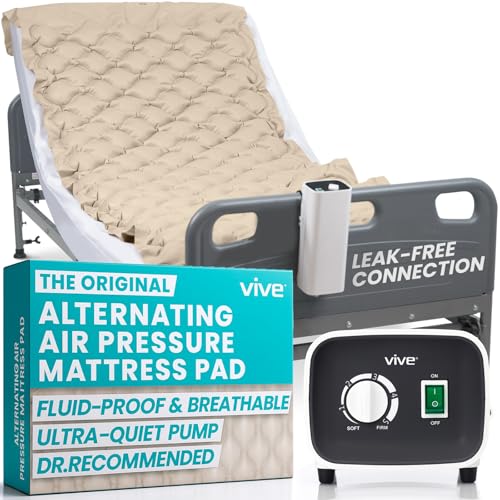
The Vive pad offers 130 air cells with a whisper-quiet pump and waterproof, breathable ulcer cushion. The unit promises advanced wave-like therapy for bedsores prevention and a six-minute cycle per cycle. Best for: long-term bedbound individuals needing extensive coverage and a quiet operation with strong moisture management.
Limitation: Designed as a topper, it may not replace full-length replacement systems in all clinical scenarios.
ProHeal Low Air Loss Mattress

ProHeal’s system includes 20 bladders in a cell-on-cell design with an 18-hole moisture-venting surface. It supports four therapy cycles (10, 15, 20, 25 minutes) for customized pressure relief and helps minimize moisture buildup to reduce skin irritation. Best for: users needing programmable therapy durations with moisture management features.
Limitation: The data does not specify weight limits or warranty details; verify suitability for heavier patients if required.
Buying Guide: Key Purchase Considerations
- Intended environment: Home use vs. clinical or facility settings can guide blower power, bladder durability, and maintenance needs. Choose a system with a simple alarm or diagnostic features if monitoring personnel are limited.
- Pressure redistribution and cycle length: Look for adjustable cycling times (e.g., 10–25 minutes) and the number of bladders or cells. More cells and longer cycles often improve comfort and reduce skin risk for high-risk patients.
- Surface and moisture management: Vapor barriers or breathable covers help manage moisture and reduce friction. Consider systems with moisture-wicking capabilities for long-term bed rest.
- Weight capacity and immersion: Ensure the mattress supports the patient’s weight and provides adequate immersion for comfort and pressure relief.
- Alarm and deflation features: An audible or visual low-air alarm and quick-deflate options are critical for safety and emergency responses.
- Maintenance and replacement parts: Systems with replaceable bladders or easy-to-clean covers minimize downtime and long-term costs.
- Noise level: Quieter pumps improve patient rest, particularly in home environments where disturbances matter.
FAQ
What is low air loss therapy?
It uses a mattress with numerous air chambers that alternately inflate and deflate to redistribute pressure and maintain a cooler, drier microclimate, reducing skin breakdown risk.
Who benefits most from these mattresses?
People who are bedridden, prone to pressure ulcers, or recovering from surgery, including seniors and patients with limited mobility.
How important is cycle timing?
Cycle timing helps balance pressure relief and patient comfort. Short cycles provide frequent changes, while longer cycles reduce motion for sensitive patients.
Are these systems suitable for home use?
Yes, many models are designed for home care with straightforward operation, but consider space, weight, and maintenance needs before purchase.
Do I need professional installation?
Some systems require setup by caregivers or clinicians; however, most models include user-friendly instructions suitable for home use with proper supervision.