Best Hospital Bed Air Mattress With Pump for Pressure Ulcers and Comfort
Answer: If you’re shopping for a hospital-grade air mattress topper with a pump, these top picks are designed for bedbound and immobile users to prevent and relieve pressure ulcers. Each option emphasizes alternating or low-air-loss technology, quiet operation, and reliable from-home or facility use. The best choices vary by need: home care and portability, advanced alarm features, or static-mode versatility for short-term relief. This guide highlights five strong options with clear buyer benefits and practical cautions.
| Product | Best For | Key Benefit |
|---|---|---|
| Vive Alternating Air Pressure Mattress Pad | Home care with premiere breastplate-like support | 130 air cells with whisper-quiet pump for customizable relief |
| MedVance Low Air Loss Mattress Replacement System | Long-term care or facility settings | Ultra-quiet pump, digital controls, rapid inflation, emergency CPR deflate |
| Lunderg Alternating Air Pressure Mattress Pad (Static Mode) | Caregiving at home or hospital with rest breaks | Quiet operation with Static Mode and optional flocking add-on for comfort |
| Drive Medical Med-Aire Low Air Loss Mattress | Hospitals or home beds needing moisture protection | Bottom-up pressure relief with vertical cell design and breathable cover |
| Vaunn Cloud Air Whisper Quiet Mattress Topper | Value-focused care at home with quiet pump | 130-cell wave therapy for circulation and skin health |
Vive Alternating Air Pressure Mattress Pad
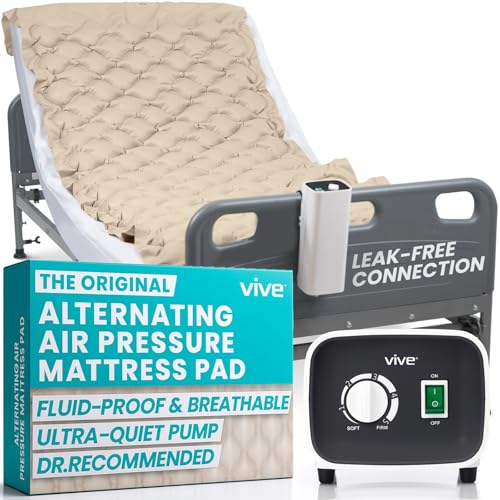
The Vive pad uses 130 air cells arranged to distribute weight evenly and reduce pressure points. It offers a whisper-quiet pump with adjustable pressure levels and a six-minute cycle for comfortable, continuous relief. This is best for bedridden individuals who require frequent repositioning and skin protection. A potential limitation is the dependency on a stable power source and proper bed attachment to prevent shifting.
Who it’s best for
- Home caregivers seeking a reliable, quiet solution for bedsores prevention
- Patients who benefit from frequent alternating pressure around the torso and hips
MedVance Low Air Loss Mattress Replacement System

This system emphasizes low air loss with eight-inch cells and a digital LED display. The ultra-quiet pump and emergency CPR-deflate feature support quick response in critical care scenarios. It’s well-suited for facilities and home use where quick inflation control and patient monitoring are important. A limitation is the emphasis on a larger system, which may require more space and setup effort.
Who it’s best for
- Care facilities needing a dependable, nurse-friendly replacement mattress
- Home users who want fast deflation in an emergency
Lunderg Alternating Air Pressure Mattress Pad (Static Mode)
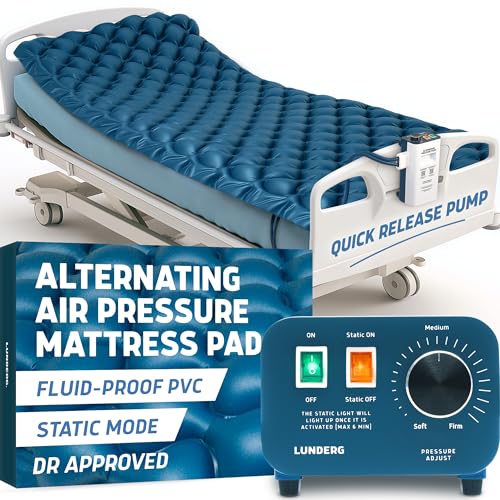
The Lunderg pad is designed to prevent bedsores with an optional Static Mode that keeps cells inflated for a steady surface. It includes a quiet pump and compatibility with hospital or home beds. The flocked add-on option enhances comfort by delivering a fabric-like surface. A caution is that users should confirm weight support and bed fit for optimal performance.
Lunderg Static Mode Mattress Pad with Flocking Add-on
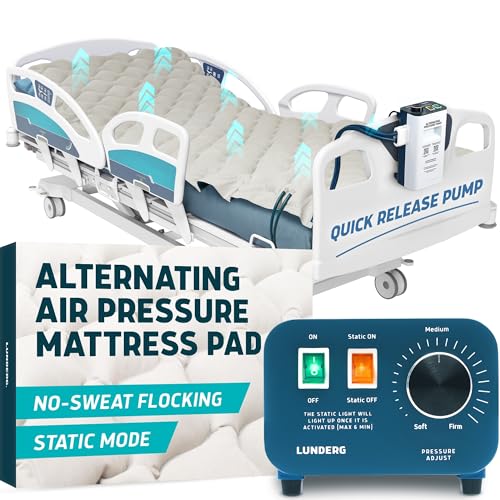
Featuring Static Mode and a flocking surface, this option is aimed at patients who rest better on a breathable, fabric-like surface without constant alternation. Its quiet operation and doctor-recommended backing support long-duration care. The limitation is that some patients may still prefer alternating relief for deeper pressure zones.
Vive 8″ Alternating Pressure Mattress

This 8-inch mattress by Vive uses multiple air chambers with a variable-pressure pump to relieve pressure spots. It supports customizable pressure settings and a static option for general use, making it flexible for different care needs. A minor drawback is that some users may require a higher or lower bed height adjustment for comfort.
Vaunn Cloud Air Whisper Quiet Mattress Topper

The Vaunn topper provides a doctor-recommended approach to easing body ulcers with constant airflow and 130 pre-programmed cells. The wave-like therapy is designed to relax muscles and improve circulation. It suits patients who need a cooling, continuous surface. A caution is that setup may require careful bed alignment to ensure even compression across all cells.
Buying Guide: Key Considerations For Choosing An Air Mattress With Pump
- Care setting: Home use vs. facility use determines the need for digital diagnostics, alarms, or robust durability.
- Pressure relief method: Alternate pressure, low air loss, or static mode each offers different relief profiles; choose based on skin health and mobility.
- Pump noise and speed: Ultra-quiet pumps foster better sleep; consider cycle duration and whether constant airflow is desired.
- Weight capacity and size: Ensure compatibility with the bed home or hospital bed, plus patient weight limits.
- Power considerations: Check if power outages are common and whether a backup pump or manual deflation is feasible.
- Hygiene and covers: Look for moisture-wicking, breathable, and easy-to-clean covers to reduce skin maceration.
- Replacement parts and service: Higher-quality products often include replacement bladders or quick-connect fittings for maintenance.
Frequently Asked Questions
- What is the difference between alternating pressure and low air loss? — Alternating pressure cycles between cells to relieve pressure, while low air loss maintains surface air flow to prevent skin maceration.
- Can these toppers be used at home? — Yes, many models are designed for home care with simple setup and quiet operation.
- Is static mode useful for bed rest? — Static mode keeps all cells inflated for a stable surface, which can help rest during recovery or when movement is limited.
- Do all models require professional installation? — Most are straightforward to set up with a compatible bed frame and standard power outlet; some facility systems may require additional steps.
- How important is the pump noise level? — Quieter pumps reduce sleep disruption and improve overall comfort for long-term use.
- What about cleaning and hygiene? — Look for moisture-wicking covers and easy-to-clean materials to reduce bacterial growth and skin issues.