Best Air Pressure Mattress for Hospital Bed: Top Picks for Bedridden Care
Answering your search for the best air pressure mattress for a hospital bed: these options are designed to relieve pressure, prevent bedsores, and boost comfort for bedridden patients. They suit caregivers seeking reliable pressure relief, long-term care facilities, and home care setups. Below, five top selections are analyzed by suitability, features, and limitations to help you choose the right fit.
Summary table of selected products:
| Product | Best For | Key Benefit | Limitations |
|---|---|---|---|
| Vive Alternating Air Pressure Mattress Pad | Bedridden patients needing 130-cell coverage | Whisper-quiet pump, 130 cells for even distribution | Higher complexity may require setup time |
| MedVance Low Air Loss Mattress | Users needing quick inflation and alarms | Ultra quiet, digital alarms, fast setup | Digital features may require familiarity |
| Lunderg Alternating with Static Mode | Caregivers seeking both alternating and static options | Static mode for stable surface, quiet pump | Includes additional comfort layer add-on |
| Kekoy Alternating Pad | Early-stage pressure sore prevention | 130 cells, 75″x35″ size, durable cover | Primarily focused on prevention, not full system |
| Vaunn Cloud Air Whisper Quiet | Budget-friendly comfort with wave therapy | Air-lift distribution, 130 cells, quiet operation | Standalone system may have fewer advanced alarms |
Vive Alternating Air Pressure Mattress Pad
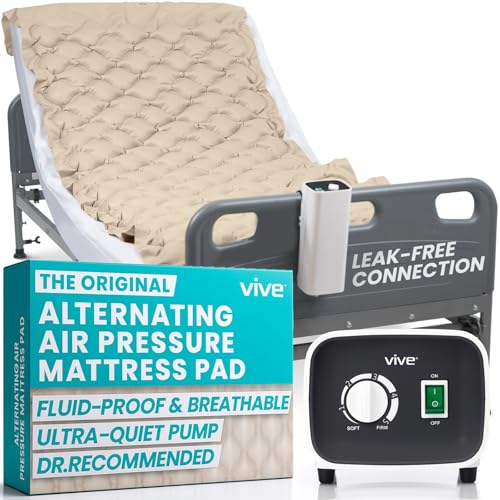
The Vive pad uses a 130-cell arrangement with an alternating therapy algorithm to distribute weight and reduce pressure spots. It includes a whisper-quiet pump operating at about 22 dBA, and cycle duration around six minutes for continuous, comfortable relief. Best for immobilized patients who cannot shift weight regularly, including those at risk of ulcers.
Best for: bedridden individuals needing comprehensive, even pressure distribution. Why selected: 130 cells provide broad coverage; the quiet pump minimizes sleep disruption. Limitation: setup and maintenance may require careful monitoring to prevent leaks.
MedVance Low Air Loss Mattress Replacement System

This system features an ultra-quiet pump with dual cores and a digital LED control that displays weight and pressure. It includes a fast inflate function and an emergency CPR deflate option via a red tag, plus a low-air-loss design that prevents bottoming out. It is ideal for long-term care where precise pressure control and alarms are beneficial.
Best for: users needing quick inflation, simple digital diagnostics, and alarm features. Why selected: strong emphasis on safety alarms and rapid deflation in emergencies. Limitation: may be more complex to operate for first-time users.
Lunderg PressuRelief Alternating Pad with Comfort Layer

This model emphasizes caregiver comfort with a PressuRelief Comfort Layer and a quiet 23 dBA pump. It offers both alternating therapy and a static mode for a stable sleeping surface. Designed for hospital beds and home use, it supports up to 300 lbs, making it suitable for many patients.
Best for: caregivers who want a familiar feel plus quiet operation. Why selected: combines gentle wave-like therapy with the option of static support. Limitation: includes an added comfort layer that may slightly alter fit for some bed configurations.
Kekoy Alternating Air Pressure Mattress Pad

The Kekoy pad uses 130 air cells with a waterproof cover to help redistribute pressure and reduce skin stress. It is designed for elderly care, bedridden users, and post-surgery recovery, with emphasis on early-stage prevention. It is compatible with hospital beds and home setups alike.
Best for: early-stage prevention and daily pressure redistribution. Why selected: 130 cells and waterproof cover provide robust protection and comfort. Limitation: focus leans toward prevention rather than a full system upgrade; ensure compatibility with your bed.
Vaunn Medical Cloud Air Whisper Quiet Mattress Topper

The Vaunn topper uses revolutionary air-lift technology with a 130-cell arrangement to distribute airflow along the body, promoting circulation and reducing pressure spots. It combines an air-lift system with an advanced sleep wave therapy to create a cooler, comfortable surface for extended rest.
Best for: users seeking a balance of comfort and affordability. Why selected: strong airflow distribution and wave-like therapy. Limitation: as a topper, it may require careful fit on some beds to avoid gaps at edges.
Buying Guide: How to Choose the Right Air Pressure Mattress
What length and size do I need? Measure your hospital bed with standard dimensions; most toppers are 75″ long or shorter. Ensure the pad covers the footprint of the bed and has a snug fit to prevent bunching or slipping.
What level of pressure relief is required? Consider the patient’s risk level for bedsores. High-risk patients benefit from 130-cell configurations and continuous weight redistribution, while lower-risk users may do well with static modes.
How important are noise and alarms? If the patient sleeps deeply, a low-noise pump (below 25 dBA) and digital alarms for weight and pressure can improve safety and comfort.
Is the product easy to maintain? Look for waterproof covers, leak-resistant cell construction, and clear cleaning instructions. Durable materials reduce maintenance and replacement needs over time.
What features justify the price? Key features include low-noise pumps, auto-alternate cycling (every 6–6.5 minutes), static mode, alarms, and easily replaceable covers or toppers for hygiene and longevity.
Is compatibility with home or hospital beds a concern? Verify weight capacity (often 250–300 lbs or more), static support options, and whether the system requires professional installation or can be set up at home.
Frequently Asked Questions
- What is an air pressure mattress for bed sores? It uses alternating or constant air cells to distribute weight evenly and reduce pressure on vulnerable areas, helping prevent bedsores.
- How does alternating pressure help bedridden patients? It cycles air in and out of cells to shift pressure away from high-risk zones, boosting circulation and promoting healing.
- Are these mattresses suitable for home use? Yes, many models are designed for home or hospital bed use, with user-friendly controls and quiet pumps.
- What should I consider regarding maintenance? Focus on waterproof covers, leak resistance, ease of cleaning, and the availability of replacement parts or covers.
- Is higher cell count better? Higher cell counts (like 130) generally provide more even pressure distribution across a larger surface area, but compatibility with your bed matters.
- Do these mattresses require professional installation? Most are designed for at-home setup; some models offer easier plug-and-play installation while others may require assistance for initial fitting.