Best Air Pressure Bed Mattress: Top Picks for Pressure Ulcers, Bedsores and Long-Term Comfort
The best air pressure bed mattresses provide alternating or low-air-loss support to reduce pressure points, boost circulation, and aid recovery for bedridden individuals. This guide highlights five reliable options suited for home care or facility use. Perfect for caregivers seeking durable, quiet, and adjustable systems, these picks are aimed at different needs—from gentle prevention to deeper pressure relief.
Buyer interests vary: choose a model with ultra-quiet pumps for quiet environments, static mode for stable sleeping surfaces, or hospital-grade reliability for long-term care. The table below summarizes key choices to help you compare quickly.
| Product | Best For | Key Benefit |
|---|---|---|
| Vive Alternating Air Pressure Mattress Pad | Most bedridden or immobilized patients | 130 air cells with whisper-quiet pump |
| Lunderg Alternating Air Pressure Mattress Pad | Home and hospital use | Static mode option with quiet 23 dBA pump |
| MedVance Premium Alternating Air Pressure Mattress Pad | Long-term care facilities and home care | Ultra-quiet digital pump with alarms |
| Vaunn Medical Cloud Air Whisper Quiet | Quiet environments, long sleeps | 130-cell wave therapy with constant airflow |
| Drive Medical Med-Aire Low Air Loss System | Simulation of hospital-grade care | 20 replaceable bladders with moisture-wicking cover |
Vive Alternating Air Pressure Mattress Pad
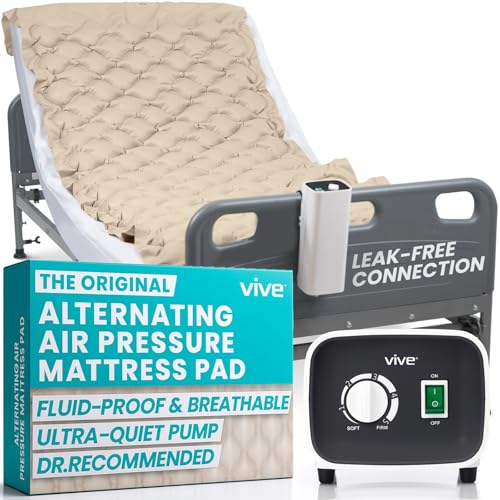
Best for: Bedridden or immobilized patients who need pressure redistribution and skin protection. The 130 air cell design distributes weight evenly to relieve pressure spots, supporting circulation and reducing the risk of ulcers.
Why selected: The combination of 130 heat-sealed air cells and a whisper-quiet pump provides durable, low-noise operation ideal for continuous use in home or care settings. The device’s algorithm alternates cell inflation to minimize localized pressure.
Limitations: The pump operates with multiple pressure levels but may require a longer setup time for first-time users.
Lunderg Alternating Air Pressure Mattress Pad
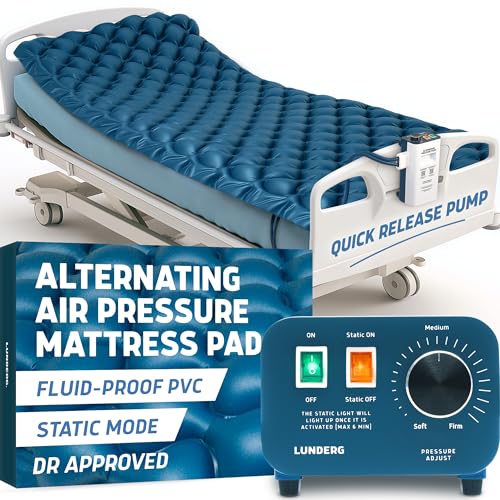
Best for: Hospitals or home care where a static mode is helpful for rest periods and caregiver breaks. It supports up to 300 lbs, making it suitable for a broad patient range.
Why selected: Doctor- and therapist-approved design with a quiet 23 dBA pump and a static mode that provides a stable surface when alternation isn’t needed.
Limitations: Static mode reduces the dynamic relief provided by alternating pressure; use intermittently for comfort variation.
MedVance Premium Alternating Air Pressure Mattress Pad

Best for: Long-term care environments and home care needing quiet operation and reliable alarm features. The digital pump with alarms supports easy adjustment and monitoring.
Why selected: This model emphasizes a quiet, consistent alternating cycle that redistributes weight every six minutes, aiming to minimize pressure buildup and promote comfort during extended use.
Limitations: As with many digital systems, occasional calibration may be required to maintain optimal cycling patterns.
Vaunn Medical Cloud Air Whisper Quiet Mattress Topper

Best for: Individuals on extended bed rest needing a gentle, continuous airflow and wave-like therapy. Ideal for those who value a cooler sleep surface.
Why selected: The 130 pre-programmed air cells provide steady airflow and wave-like therapy to improve circulation and reduce pressure spots, with a focus on quiet operation.
Limitations: May be less feature-rich for heavy-duty hospital use compared to full replacement systems.
Drive Medical Med-Aire Low Air Loss System

Best for: Care facilities or home environments seeking hospital-grade reliability and moisture management for long-term use.
Why selected: Features 20 replaceable bladders and a vapor-permeable cover that helps reduce moisture and heat buildup while delivering targeted pressure redistribution.
Limitations: System complexity and maintenance may require more caregiver attention than simpler toppers.
Buying Guide: Key Considerations For Air Pressure Mattress Systems
How to choose between alternating pressure and low-air-loss designs. Consider patient mobility, care setting, noise tolerance, and maintenance requirements.
- Alternating pressure systems cycle multiple cells; low-air-loss options reduce heat and moisture while distributing weight.
- Look for pumps advertised as ultra-quiet (under 20–23 dBA) if the user requires undisturbed sleep.
- More cells (e.g., 130) provide finer weight distribution; consider bed size and user shape.
- Helpful for periods when constant support is preferred over movement.
- Check bed compatibility and weight capacity; some toppers fit standard hospital or home beds.
- Digital panels with alarms help monitor pressure and prevent deflation risks.
Frequently Asked Questions
- What is an air pressure mattress topper? It is a sleep surface that uses air-filled cells to redistribute weight and reduce pressure on vulnerable areas.
- Who should use these products? Primarily for bedbound or immobile individuals to prevent bed sores and support healing.
- How do I choose between alternating pressure and low air loss? Alternating pressure suits those needing active pressure redistribution; low-air-loss helps regulate moisture and temperature while still providing support.
- Are quiet pumps important? Yes, quieter pumps improve rest for patients and caregivers in home and hospital environments.
- Can these products replace professional medical care? They support care but should not replace medical advice or prescribed treatments for ulcers or wounds.
- What maintenance is required? Regular cleaning, inspection of hoses and cells, and following manufacturer guidelines for pump and cover care.